Why MedTech companies, startups, and AI teams need to stop measuring activity and start designing for outcomes that drive growth, adoption, and enterprise value.

During Harvard Data Science Initiative’s 2.5-week Intensive on Agentic AI, one quote immediately stood out to me:
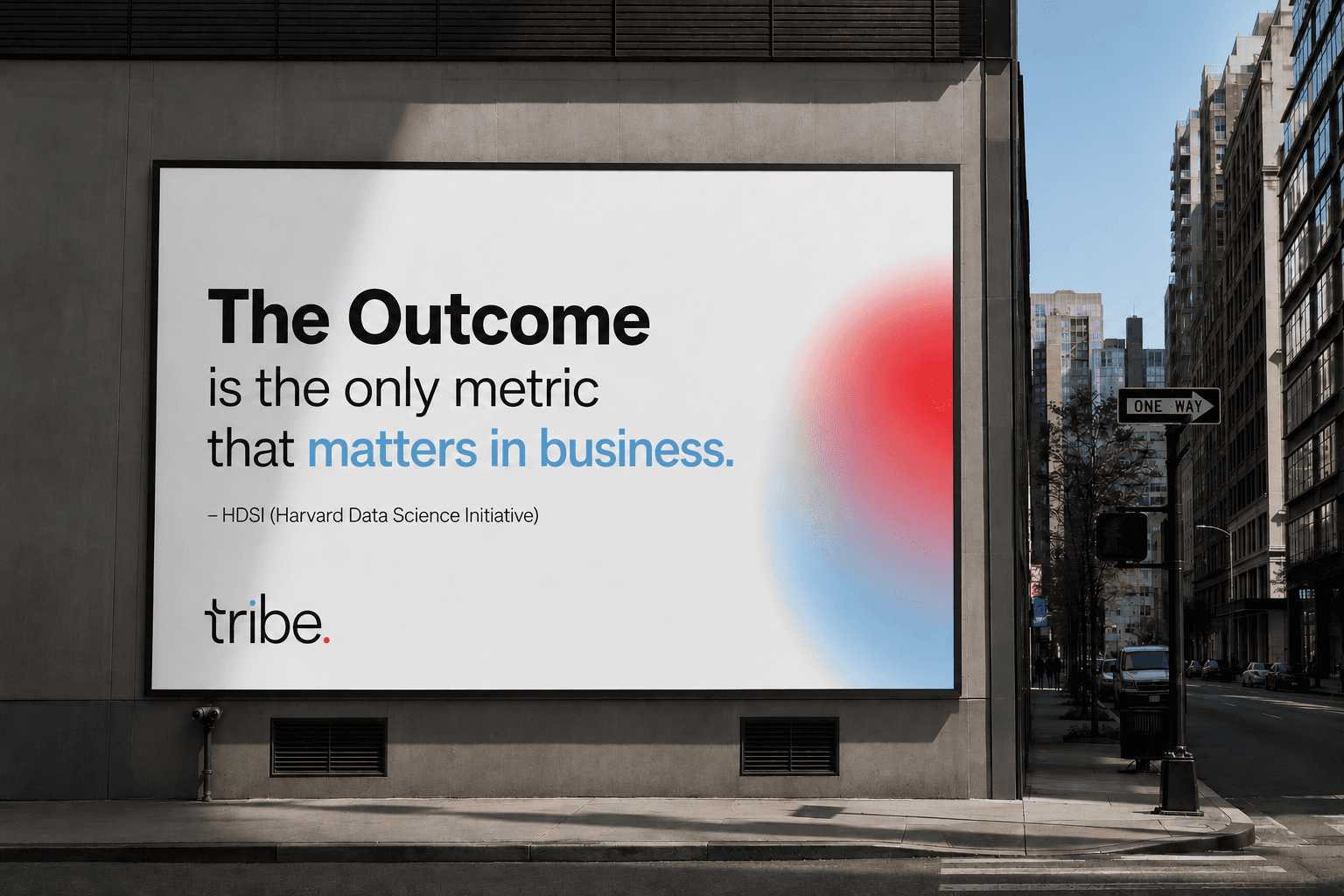
“The Outcome is the only metric that matters in business.”
It was simple, direct, and impossible to ignore.
The idea resonated because it put language around a conversation I have with clients all the time at Tribe. Whether we are working on brand positioning, investor narratives, go-to-market strategy, AI workflows, or executive thought leadership, the same issue keeps showing up in different forms.
Companies often lead with the feature instead of the outcome. They explain the product before they explain the value. They focus on the horse, while investors are still trying to understand the jockey. They talk about what they built, while the market is trying to understand what changes because it exists.
That distinction matters more than most founders realize.
In MedTech especially, the product can be technically impressive, clinically meaningful, and years in the making. But if the market cannot clearly understand the outcome, the story loses power. Customers don't want more complexity. Investors don't want more technical explanation. Strategic partners don't want a longer list of specifications.
They want to understand the value created, the friction removed, the unmet need addressed, and the commercial opportunity unlocked.
The same lesson now applies to AI.
After spending the past two years building AI workflows, agents, and operating systems inside Tribe, I have learned that AI only becomes valuable when it produces meaningful outcomes. A tool that summarizes information can be useful. An agent that helps you act on the right information at the right time can become a major business asset.
That is the difference leaders need to understand.
Why Outcome Thinking Matters Now
Business leaders have always measured activity because activity is easy to count. Marketing teams track impressions, posts, clicks, and emails. Sales teams track outreach volume, calls made, and meetings booked. Operations teams track tasks completed, reports generated, and workflows processed.
These metrics have value, but they can also create a false sense of progress.
A company can publish more content and still fail to create demand. A sales team can send more emails and still fail to improve pipeline quality. A leadership team can build more dashboards and still make slow decisions. An AI agent can produce more reports and still have no measurable impact on the business.
The real question is simple: So what?
That was one of the most valuable ideas emphasized during the HDSI intensive. When evaluating AI systems, workflow redesign, or productivity gains, the team pushed us to look past output and ask what changed as a result.
If an AI system creates a weekly market report 80 percent faster, that sounds impressive. But did the report lead to a better decision? Did it help the company enter a new market faster? Did it surface a risk early enough to avoid wasted spend? Did it help leadership reallocate time to higher-value work?
Those are the questions that matter.
The same “so what” test should be applied to brand strategy, investor decks, GTM plans, websites, content, and commercialization strategies. Speed and volume can support growth, but they don't create value on their own. Value comes from the outcome those activities create.
The Feature vs. Outcome Problem
At Tribe, we frequently help companies move from feature-led messaging to outcome-led positioning. This is especially important for MedTech companies because the internal team often has deep technical fluency. They know engineering. They understand the clinical workflow. They can explain the product architecture, regulatory pathway, mechanism of action, and competitive differentiation in detail.
That knowledge is important, but it can also become a trap.
The market doesn't always need the full technical download first. The market needs a reason to care.
A founder may want to explain the product’s proprietary design, while an investor is trying to understand whether the company can create a category. A marketing team may want to lead with product specifications, while the customer is trying to understand how the technology improves workflow, outcomes, economics, or confidence. A company may want to describe every feature, while the board is trying to understand whether the narrative supports fundraising, adoption, and enterprise value.
This is where the old marketing idea of “selling the hole, not the drill” still applies. In MedTech, we could take that even further. The product is rarely the full story. The stronger story is the outcome it makes possible.
A catheter is not only a catheter. It may represent faster access, improved procedural confidence, expanded treatment opportunities, or a more efficient clinical workflow.
A robotic platform is not only a robot. It may represent consistency, precision, scalability, surgeon confidence, hospital differentiation, or a pathway to new standards of care.
An AI tool is not only a tool. It may represent faster decision-making, better prioritization, reduced administrative burden, stronger signal detection, or a new operating model for the business.
When companies make that shift, messaging becomes clearer. Investor conversations become stronger. Sales teams become more confident. Websites become more useful. The company’s strategic narrative starts working harder.
The Same Problem Shows Up in AI
The HDSI intensive focused heavily on agentic AI, workflow redesign, and the difference between retrofitting AI into existing systems versus redesigning work around a better outcome.
This is a critical distinction.
Many organizations are still approaching AI from the wrong starting point. They look at an existing and human workflow and ask how AI can make it faster. That can create incremental efficiency, but it rarely creates transformational leverage.
The better question is: if we were designing this workflow today, with AI available from the beginning, what would the process look like?
That question changes the work.
A traditional process may involve research, a meeting, a summary, another meeting, a handoff, a report, and then a decision. A redesigned AI-enabled process may collapse several of those steps by turning information into recommended action faster. The value comes from reducing friction, improving decision quality, and giving human leaders more time to focus on judgment, relationships, and strategy.
This is where AI becomes much more than a productivity tool.
Over the past two years, I have spent a significant amount of time improving our AI workflows and agentic employees at Tribe. The goal has never been to create agents that simply report the news or regurgitate noise. There is already too much information in every business. More summaries alone don't solve the real problem.
The higher-value opportunity is building systems that identify signals, recommend action, and help the business move faster with more clarity.
That shift has shaped the way I now think about AI advisory work. An agent should have a job to do. It should solve an unmet need, create leverage, reduce friction, support better decisions, or help the company act on something that matters. If it doesn't create value, drive action, or support transformation, the business should question why it exists.
How Jarvis Changed My Own Business
One of the biggest outcomes of this season has been building my own Chief of Staff Agent and real-time command center named Jarvis.
This was a major turning point in how I operate Tribe.
For the past several months, I have been upgrading my own AI agent playbook, testing workflows, improving signal scanning, and building systems that support the way I actually work as a founder and advisor. Jarvis became the layer that helps me synthesize priorities, surface opportunities, identify risks, organize moving pieces, and stay focused on the highest-value decisions day to day.
That experience changed AI from a nice-to-have into an integral employee in my business.
I don't think of Jarvis as a tool sitting on the side of the business. I think of it as a high-value employee that helps extend my thinking, protect my time, and increase the quality of execution. The value is not that it gives me more information. The value is that it helps me do more with the right information.
That is the outcome.
For a founder, that kind of leverage matters. Most of us don't need more tabs open, more notifications, more dashboards, or more disconnected tools. We need systems that help us see clearly, decide faster, and move the business forward.
This is also why I believe AI advisory has to be grounded in business strategy, not tool selection alone. The tool is only one part of the equation. The real value comes from understanding the workflow, the decision points, the risks, the team dynamics, and the business outcome the system is meant to support.
Outcome Architecture: The New Competitive Advantage
One of the biggest themes from the HDSI intensive was that the technology layer is becoming increasingly accessible. Many companies now have access to the same models, tools, and infrastructure. Access alone will not create a durable advantage.
The advantage will come from how leaders design the business around outcomes.
I think of this as Outcome Architecture.
Outcome Architecture is the discipline of designing strategy, messaging, workflows, AI systems, and go-to-market plans around the business result that matters most. It starts with the end state and works backward. It asks what needs to change, what decisions need to improve, what behavior needs to shift, what friction needs to be removed, and what value needs to be created.
For a MedTech company, that may mean designing a brand narrative around adoption and category leadership instead of product description. For a startup raising capital, it may mean building an investor deck around market transformation and enterprise value instead of technical explanation alone. For a growth-stage company, it may mean redesigning workflows so the team spends less time gathering information and more time acting on the right opportunities.
For AI, Outcome Architecture means building agents around meaningful business jobs. An agent should have a clear purpose, defined inputs, decision logic, escalation paths, and measurable value. In regulated or high-stakes environments, this also requires thoughtful governance. Leaders need to know where autonomy makes sense, where human review is required, and where risk needs to be tightly controlled.
The goal is not maximum automation. The goal is intelligent leverage.
That distinction is especially important in MedTech and healthcare-adjacent industries, where reputation, compliance, patient impact, clinical trust, and investor confidence all matter. AI strategy in these environments cannot be reckless. It needs to be practical, governed, and tied to clear business outcomes.
How Tribe Applies This Work
At Tribe, this outcome-first perspective now sits at the center of how we approach growth, brand, AI, and commercialization strategy.
In our Brand Overhaul™ work, we help companies clarify what they want the market to understand, believe, and act on. The work may include messaging, website strategy, visual identity, and executive narrative, but the real goal is stronger market clarity.
In our GTM Sprint™, we help teams move from scattered activity to a focused commercialization plan. That means defining the right customer, the right message, the right sales motion, the right proof points, and the right next steps to support adoption.
Through Fractional Growth + AI Advisory™, we help leadership teams think through both growth strategy and AI-enabled leverage. This includes identifying where AI can improve decision-making, streamline workflows, elevate the team, and support revenue-generating activities.
Through Principal Voice System™, we help founders and executives turn their expertise into a stronger market-facing point of view. For many companies, the founder’s voice is one of the most underused strategic assets in the business. When positioned well, it can support trust, fundraising, partnerships, recruiting, and category leadership.
Across all of these services, the principle is the same. We are not building assets for the sake of assets. We are building systems, stories, and strategies designed to create business outcomes.
The Question Leaders Should Keep Asking
Every company should be asking harder questions right now.
What outcome does this product create?
What unmet need does this solve?
What action should this message drive?
What decision and action should this AI agent improve?
What business result should this workflow support?
What transformation should our brand make easier to understand?
These questions are simple, but they expose where companies are over-investing in activity and under-investing in clarity.
The outcome is where the value lives. It is what customers respond to, what investors evaluate, what teams align around, and what markets reward. Features matter. Technology matters. Execution matters. But all of those elements need to connect to a meaningful result.
That is the whole point of building anything.
If it doesn't create value, meet an unmet need, support action, reduce friction, improve a decision, or drive transformation, the business has to ask what it is really for.
That applies to products. It applies to brands. It applies to AI agents. It applies to investor decks. It applies to content. It applies to companies.
The outcome is the metric that matters because the outcome is the reason the work exists.
Ready to Build Around the Outcome?
At Tribe Consulting, we help MedTech and growth-stage companies clarify the outcomes that matter most, then build the brand strategy, growth systems, AI workflows, investor narrative, and go-to-market plan to support them.
If your company is preparing for fundraising, commercialization, category creation, AI adoption, or a strategic brand shift, now is the time to move beyond activity and build around the outcome.
Book a strategy call with Tribe Consulting to explore how our Fractional Growth + AI Advisory™, GTM Sprint™, Brand Overhaul™, and Principal Voice System™ can help your company create clearer strategy, stronger positioning, and higher-value growth.
Book a discovery call: tribeconsulting.co