The rules of digital visibility have changed. Hospital buyers, clinicians and healthcare executives are increasingly turning to AI tools like ChatGPT and Google AI Overviews for answers instead of traditional search engines. That means your company's visibility is no longer determined solely by your website or SEO strategy, it's shaped by whether AI can find credible experts talking about your category. Here's why the most valuable search asset your MedTech startup has isn't your website. It's your people.

The New Rules of MedTech Visibility
For the last decade, early-stage MedTech companies operated with a highly predictable digital playbook. You built a pristine corporate website, published a few clinical whitepapers, and relied on traditional SEO tactics to optimize your keywords. You assumed that if your technology was superior, hospital procurement officers would inevitably find you through a standard web query.
But search behavior has fundamentally fractured.
Physicians, Chief Medical Information Officers, and hospital administrators are rapidly abandoning traditional search engines. They aren't searching anymore, they're asking. They're turning to generative AI models to research clinical workflows, compare integration capabilities, and evaluate new medical devices. These platforms don't provide a list of links. They provide a single, definitive answer synthesized from across the web.
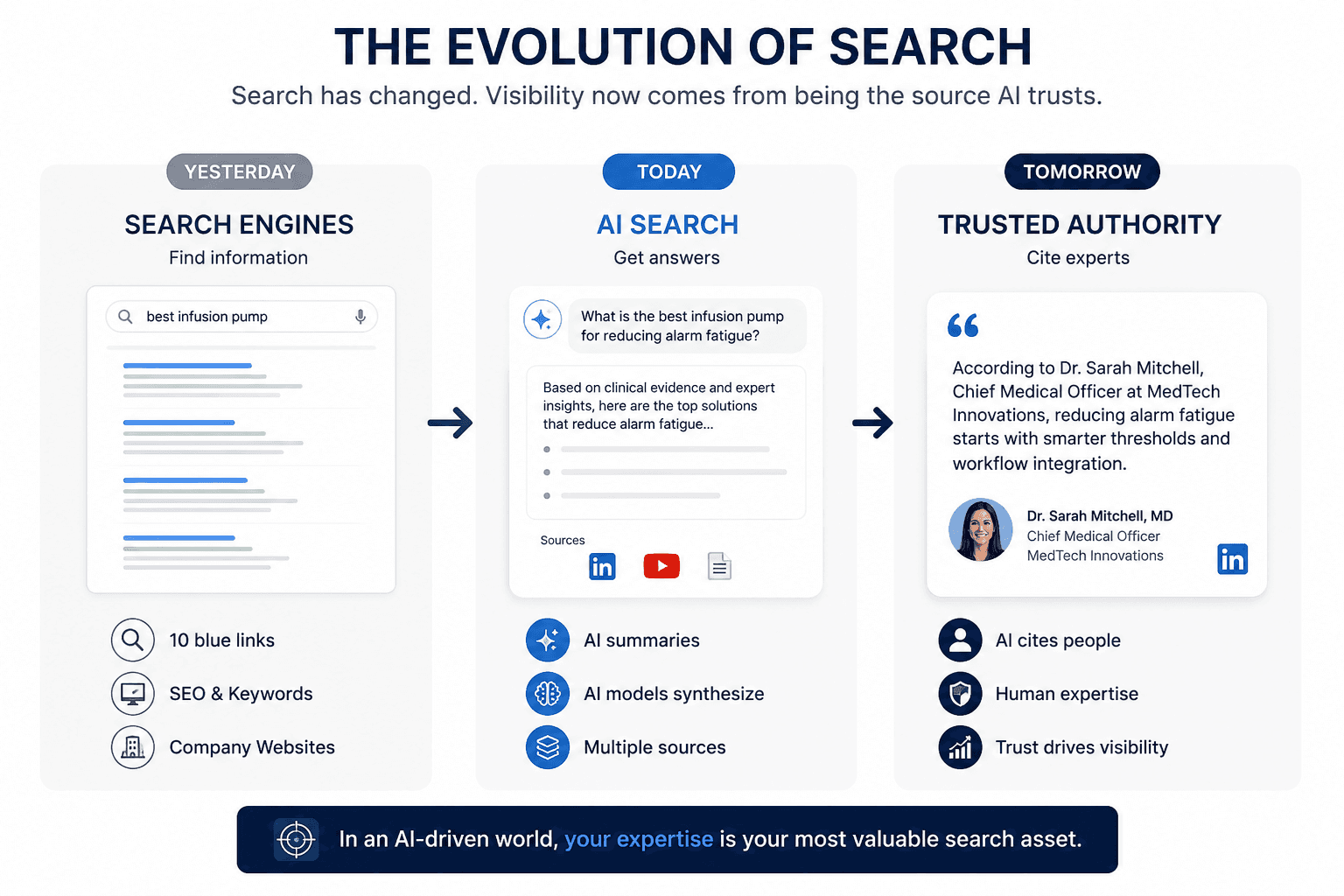
To understand exactly how these algorithms build their responses, LinkedIn recently partnered with Meltwater to track 9.5 million AI citations across major models like ChatGPT, Copilot, and Google AI Overviews. The research revealed something massive: LinkedIn is the #2 most-cited source for AI-powered search engines, second only to YouTube.
AI models are absolutely hungry for structured, expert-led business content, and they're increasingly scraping LinkedIn to find it.
But here’s the catch: the algorithms aren't looking at your corporate website or your company page.
Why Algorithms Prefer People Over Company Logos
The Meltwater data revealed that 75% of all LinkedIn citations used by AI engines come from individual member profiles, while only 25% come from Company Pages.
Algorithms have learned what hospital buyers have known for decades: corporate logos don't have opinions. They don't have clinical experience. They don't carry the battle scars of navigating FDA clearance or implementing software across a fragmented hospital system. Corporate pages publish sanitized marketing material; people publish genuine insights.
AI engines are explicitly programmed to hunt for verifiable human expertise. When a model needs to synthesize an answer about a complex clinical workflow, it actively seeks out the credentialed physician, the experienced founder, or the seasoned operator. It looks for authority signals in a user’s profile, like their job title, company, and industry background, to confidently reference them.
According to the report, CEOs and founders produce the most cited content on the platform. This presents a massive structural advantage for early and growth-stage MedTech startups. You don't need the multimillion-dollar marketing budget of a legacy healthcare giant to win visibility in the AI era. You simply need to unleash the inherent authority of your leadership team on LinkedIn.
The Brand Echo: Why Showing Up Lifts the Whole Company
The LinkedIn report made another vital point: while individual member content gets cited more often, the goal isn't just to build a personal brand. The goal is corporate visibility.
When an employee with deep expertise posts regularly, they generate significant visibility for their entire organization. The combined force of personal expertise and corporate backing is what ultimately wins in AI search.
At Tribe Consulting, we call this the Brand Echo. People trust people before they trust companies. But when your executives show up online with a strong, original point of view, that trust and visibility naturally echoes right back to your company. You aren't just posting for yourself; you're creating the digital breadcrumbs that lead AI engines directly to your product.
How to Create "AI-Citable" MedTech Content
Understanding that algorithms prefer individual experts is only the first step. You also have to format your point of view in a way that machines can easily parse, categorize, and cite.
Based on the LinkedIn and Meltwater research, here's how you structure your daily presence to make sure AI engines choose your executives as the definitive source:
Create Practical Frameworks: AI engines prioritize content that solves specific operational problems. Listicles, decision frameworks, and vendor comparisons make up 54% of the most cited content. If your Chief Medical Officer publishes a step-by-step blueprint on how to reduce nursing alarm fatigue, the algorithm will latch onto that structure.
Give Direct, Structured Answers: Machines process patterns, not prose. Bulleted or numbered lists were used in every single top-cited article in the study, and clear headings were present in 92% of the most successful posts. Give the direct, factual answer in the very first sentence, and then use bullet points to break down the clinical details.
Prioritize Freshness and Consistency: You can't rely on a single viral article from two years ago. The data shows that 48% of successful AI citations were published within the last three months, and only 12% of cited material was older than a year. If you aren't posting regularly, you're invisible to the machine.
The Danger of Quiet Commercialization
Many brilliant MedTech founders assume their clinical data will simply speak for itself. They choose to be "quiet builders," staying behind the scenes while leaving market education to faceless corporate marketing or automated email sequences.
But in an AI-driven world, this is a critical strategic error.
Your clinical efficacy doesn't help your market position if it remains trapped inside closed-door board meetings. Buyers are desperately looking for a human signal they can believe in. When your leadership team remains digitally invisible, your company takes on immense, unnecessary risk.
You force your sales team to build trust from scratch on every single discovery call. You allow competitors with inferior technology, but louder, more active executives, to define the category narrative. Most dangerously, you ensure that AI search engines will never cite your company when hospital buyers ask for the best solution in your space.
Engineering Your Authority: Principal Voice System™
Most founders, executives, and MedTech operators already possess massive amounts of authority. You have the clinical depth and the operator perspective. You simply haven't extracted that expertise and turned it into scalable media assets.
You don't need a personal branding coach. You need your intellectual identity engineered.
That's exactly why we developed the Principal Voice System™ and Brand Echo™ at Tribe Consulting. Designed specifically for early and growth-stage MedTech innovators, our strategic framework extracts, defines, and structures the authentic voice of your leadership team. We identify your core operator perspective and translate it into a compelling category narrative that algorithms and human buyers both trust.
Capturing the Human Element with Tribe Studio
We know that MedTech leaders are incredibly busy running their startups. You can't pause your commercialization efforts to sit at a desk and write LinkedIn posts. You need a dedicated, strategic creative partner who understands both the clinical nuance of your industry and the technical demands of modern AI search.
We solve this through Tribe Studio (2 hour Virtual) Recording Sessions.
We capture months of high-signal video and audio content during a single, highly focused recording day. We sit down with you, guide the conversation, and extract your deepest clinical and industry insights. You simply show up and share your expertise. We handle the rest.
Our Brand Echo™ operating system then takes those recordings and transforms them into the exact media assets your company needs. We build the verifiable digital footprint that professional networks and AI algorithms actively seek out and cite.
Your old SEO machine isn't serving you anymore, and the window to capture the AI citation landscape is open right now. It's time to step out from behind the corporate logo and let your Principal Voice echo through your entire industry.
Ready to operationalize your executive authority?
👉 To find out more about our Principal Voice and Brand Echo solutions for executive branding, go to: https://www.tribeconsulting.co/tribe-studio