Most MedTech companies don't have a strategy problem, they have an execution problem. Learn why consistent content execution builds pipeline and how to create marketing infrastructure that keeps your brand visible to buyers.

Most MedTech commercial teams treat content like a proof of life. Post three times a week, stay consistent, stay visible. The logic sounds right. And then six months later, the content calendar is full and the pipeline isn't.
That disconnect isn't a failure of effort. It's a failure of design.
There's a version of content that builds brand awareness and a version that builds pipeline, and they're not the same thing. Most teams are doing the first while measuring for the second, and wondering why the numbers don't add up.
The Post That Nobody Does Anything With
Here's the pattern I see across clinical-stage and post-GTM MedTech companies. The company posts. The post gets engagement from colleagues, existing partners, maybe a handful of followers who already know the brand. The marketing team reports the impressions. The leadership team feels good about visibility.
Nothing books a call.
Then someone says "we need to post more," and the cycle restarts at higher volume.
The content isn't broken. The architecture underneath it has a gap. You can fill a feed with perfectly reasonable posts and generate exactly zero qualified conversations if the posts aren't connected to anything, no offer, no entry point, no sequence that converts attention into relationship.
Attention is just the first inch. Pipeline starts after someone decides to take a step.
What Pipeline Content Actually Does Differently
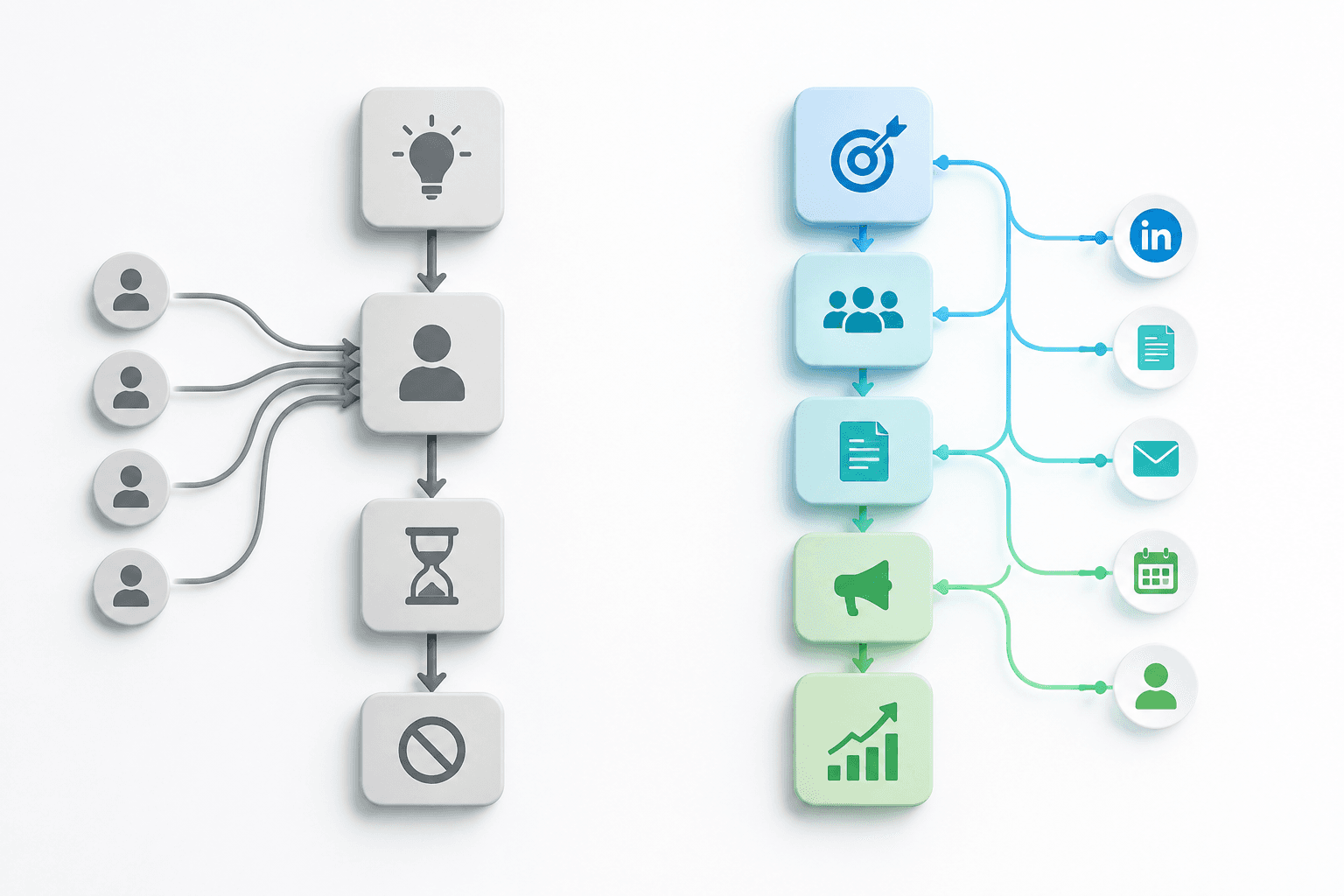
There are four things content that generates real commercial conversations tends to do, and most standard "visibility content" skips all of them.
It speaks directly to a pain the buyer is actively living. Not "the challenges of MedTech commercialization" in the abstract. Something specific enough that the right person reads it and thinks, that's my quarter. In a 12-to-18-month sales cycle, your buyer is somewhere in the arc at any given moment, fundraising pressure, a market access problem they haven't solved, a launch that's falling behind. The post that names where they're right now earns more than the post that describes your capabilities.
It makes the problem cost visible. "Posting Isn't Pipeline" isn't a nice-to-know insight. The implication is that something is being wasted, time, spend, runway, on activity that isn't converting. Pipeline content doesn't leave that implication vague. It shows the cost of the current approach clearly enough that the reader feels the weight of it.
It introduces a mechanism. Visibility content educates. Pipeline content does that and then shows the path. A mechanism is a specific, named way of getting from the problem to the outcome. It doesn't have to be proprietary. It has to be specific enough to be believable and simple enough to be memorable. The Five Ones. The Execution Gap. These aren't buzzwords; they're mental models that make the next step obvious.
It has one specific ask. Not "check out our services" and a link. A specific invitation tied to the specific pain in the post. Comment "GAP" and I'll send you the checklist. Book a 20-minute call if this is your July. One door. Not the full menu.
Most content has none of these four things. Which is why most content generates awareness and not pipeline.
The Structural Problem Nobody Talks About
The deeper issue is that content strategy in MedTech is often separated from commercial strategy. Marketing produces the content. Sales manages the pipeline. The two teams report to different people, use different tools, and rarely sit in the same room when the content plan is being built.
So the content reflects the brand and the product, but it doesn't reflect where the buyer actually is in the conversation. It doesn't align with what the commercial team is hearing in the field. It doesn't tie to the specific entry points the company is trying to create.
You end up with a feed that looks polished and a pipeline that looks empty. And because both of those things are someone else's problem, the feedback loop never closes.
The companies getting consistent inbound from content have usually solved this at a structural level. The person building the content strategy knows what the commercial team is hearing. The content calendar is mapped to buyer journey stages, not just to arbitrary topics that feel interesting. Every piece has a defined conversion point, not just a hope that awareness compounds into revenue on its own.
What The Calendar Actually Needs
This isn't a call to post less. Consistency still matters in MedTech because the sales cycle is long enough that your buyer is watching for months before they do anything. Going dark costs you the deal you didn't know you were almost winning.
But the calendar needs a different architecture.
The top layer is visibility content, positioning, proof of expertise, category leadership. This is what most teams already do reasonably well. It keeps the brand warm for the buyers who are six months from a conversation.
The middle layer is education content that surfaces the mechanism. This is where you name the specific problem you solve and show how you solve it. Not case studies with names redacted. Specific frameworks. Specific diagnostic questions. Content that lets the buyer self-identify.
The bottom layer is conversion content. This is the post with a real offer, a real ask, a real entry point. Carousel posts with a "Comment GAP" CTA. A post that offers one specific thing, a checklist, a 20-minute call, a direct question, to the person who read all the way to the end.
Most teams fill the top layer and ignore the middle and bottom. That's why the pipeline stays empty. The buyer got warmed up and then had nowhere to go.
The Number That Tells You If It's Working
Impressions don't tell you if your content is building pipeline. Neither does follower growth, or even saves and comments, though those are better signals than raw reach.
The number that matters is this: how many conversations did your content start this quarter that weren't already in the funnel?
If the honest answer is zero or near-zero, the content is doing brand maintenance, not commercial work. That's fine if you've budgeted for brand maintenance. It's a problem if the goal is pipeline.
The fix isn't more content. It's content that's designed for the whole arc, awareness to interest to ask, and built with someone who knows where the commercial conversation is supposed to go.
That's what Marketing On Demand™ is actually built to do. Not a content calendar. A commercial engine that runs between conferences, keeps the brand visible, and creates real entry points for the conversations that actually close.
If your feed is active and your pipeline is quiet, you're probably missing the middle and bottom layers. That's the gap. And it's almost always fixable faster than you'd expect.
Book a Marketing On Demand strategy call at tribeconsulting.co and we'll show you what the architecture looks like for your specific stage and market.