Founders have undeniably strong clinical data. Yet, hospital systems aren't returning calls and investors won't commit. They think the answer is more salespeople or marketing spend, but the real breakdown is a devastating positioning gap. Here is where commercialization actually fails, and how to fix it fast.

When a product fails to scale, founders almost universally look in the wrong direction. Commercialization failures rarely stem from the product not being good enough. The breakdown occurs at the message, and most founders don’t realize this until they are already sitting in the most important room of their company’s life.
I’ve sat across from countless MedTech founders who have executed flawlessly on the clinical side. Their data is undeniable, their safety profile is pristine, and their regulatory pathway is absolutely clear.
Yet, despite everything, they are stalling.
Hospital systems aren’t returning calls. Investors are circling but refuse to write the check. Conversations with Key Opinion Leaders (KOLs) are polite, even warm, but nothing actually moves. The entire pipeline feels like walking through deep sand.
The reflex response is almost always the same. Founders assume they need more resources. They think the answer is more sales reps, a bigger marketing budget, or a more aggressive conference presence.
What I’ve seen as an operator, over and over, is that the real breakdown is a devastating lack of clarity.
The Sophisticated Market Copes with Static Messaging
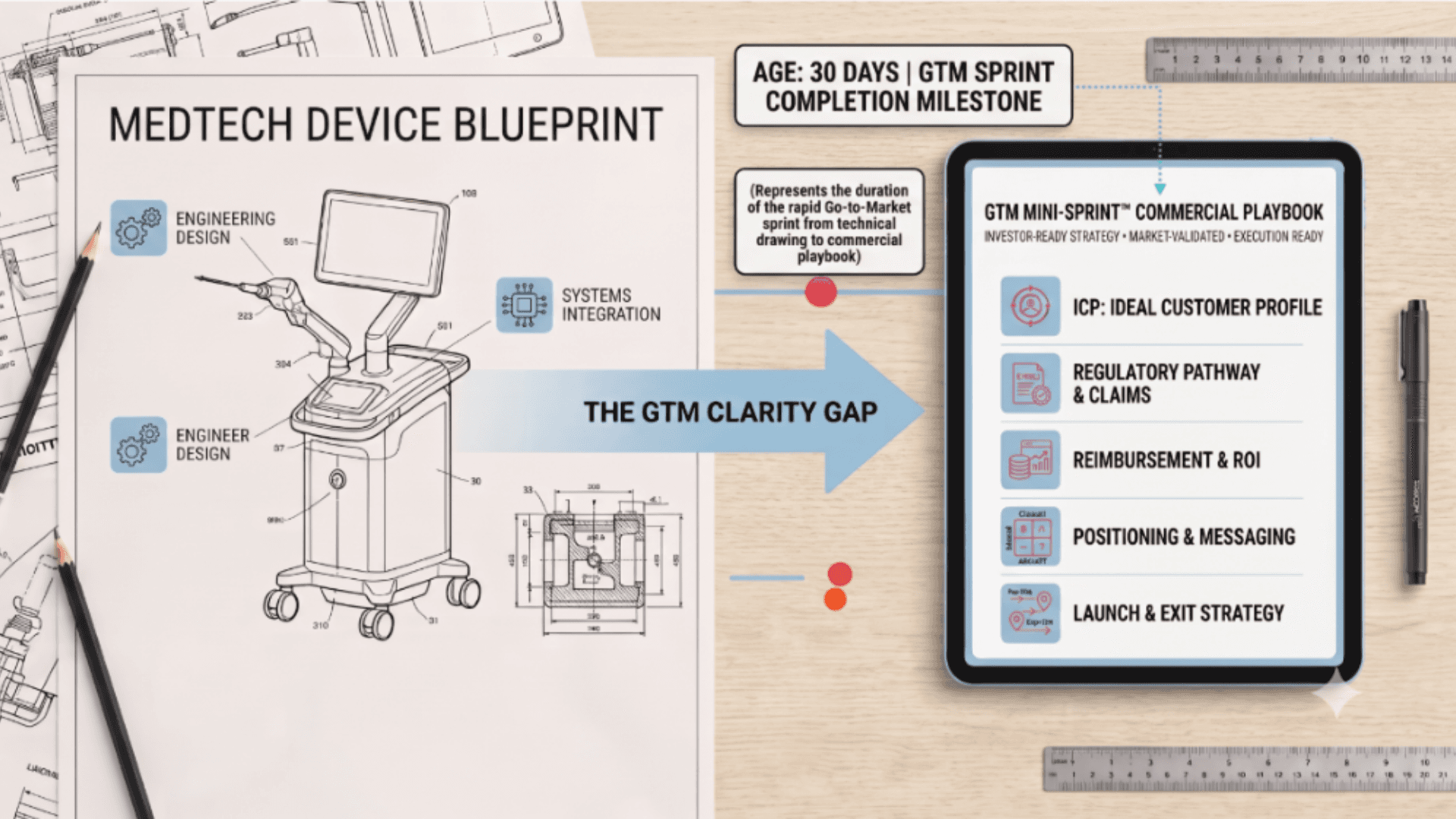
Buyers in the healthcare landscape are incredibly sophisticated, whether they are health system executives, members of a hospital procurement committee, or institutional investors looking at a Series B. This audience is not waiting for more information about your technology or your product features.
They are waiting for a definitive reason to believe that your solution is the only logical answer to their specific, immediate problem.
There is a measurable gap between what your product does clinically and why a specific buyer should care about it personally. This gap represents a profound positioning failure. Most MedTech companies have this gap because they were never told that building a commercial story was distinct from building a clinical story.
The clinical story answers the question: does this work?
The commercial story answers the question: does this work for me, right now, better than what I’m already doing?
Only one of those narratives actually closes deals.
The Three Places Your Commercialization Actually Breaks
In my consulting work with MedTech organizations, the commercialization breakdown almost always occurs in one of three critical areas.
1. Your ICP is dangerously vague.
When you define your ideal customer profile (ICP) as "surgeons" or "health systems," you have defined a broad category, not a specific target. I mean that you must identify: which specific physician, at which exact stage of their career, dealing with which specific clinical or operational pressure, inside which precise type of institution? When you don’t have a defined Principal Voice from an executive leader speaking directly to that specific person, your message will not land. A vague ICP produces a vague pipeline every single time.
2. You lead with features instead of the buyer's reality.
This is the most common trap. You spent years building the technology, so that’s what you lead with. You say, "Our device delivers X through Y mechanism using Z materials." But your buyer does not care about any of that, not yet. They care about their patient outcomes, their operating room efficiency, and their reimbursement exposure. If you want a commercial effect, you cannot lead with static tech. Your Brand Echo must amplify how your solution improves their specific world, not glorify your engineering.
3. Your narrative provides no reason for urgency.
There is a difference between a standard GTM pitch deck and a category story that actually moves buyers to act. A standard deck explains things. A real category story makes the buyer feel the problem so viscerally that doing nothing becomes the riskier option. Most companies have the standard deck, but very few have built the story that eliminates the status quo.
When Commercial Story Readiness Replaces the Boulder uphill.
When you get this right, when you have a precisely defined buyer, a message that truly speaks their language, and a category narrative that creates movement, commercialization stops feeling like you’re pushing a boulder uphill.
The right conversations start earlier. The right investors find you more compelling. Your clinical data lands differently because it is now anchored to a story the buyer was already telling themselves about their own future success.
I've watched companies go through our positioning work and emerge with a fundamentally different commercial identity. They shifted buyers from "this is an interesting piece of clinical tech" to "when can we start this pilot?" That shift didn’t happen because we changed the product. It happened because the story finally fit the person holding the budget.
That’s not a marketing trick. That’s the real work of commercialization.
MedTech M&A is accelerating rapidly. Any company going to market right now, whether to raise capital, to scale commercially, or to sell the asset entirely, requires total commercial story readiness before they walk into that room. You must have an established Principal Voice to command that room, and your message must echo far beyond it.
Most don’t have it. Worse, most don’t even realize it’s the thing that’s actually missing.
Where You Must Start
If your commercial efforts are stalling and your first instinct is to hire more salespeople or spend more on promotion, you must hit pause.
Instead, ask yourself if every single person on your commercial team can answer these three questions in under 60 seconds.
Who exactly is this solution for? What specific problem does it solve for them in their own words? Why is doing nothing or staying with the current solution the far worse option?
If the answers are inconsistent or vague across your team, you don’t have a resource problem. You have a massive positioning problem.
Positioning problems are fixable. We designed the GTM Mini Sprint at Tribe Consulting specifically to diagnose, fix, and operationalize your commercial position and narrative in days, not months, so you have the confidence you need when you get in the room.
Are you ready to commercialize your message as effectively as you commercialized your product?
→ Click here to schedule a conversation and learn more about our GTM Mini Sprint and Principal Voice solutions.